


Blog
Why OKX Sign In Feels Safer Than You Think — and Where That Confidence Breaks Down

Surprising fact: a modern crypto platform can combine cold-storage security for the vast majority of assets with a friction-light sign-in flow that still uses biometric and AI detection. OKX is an example of that tension — it aims to be both highly secure and highly accessible. For a U.S. trader who wants to log in, deposit, stake, trade derivatives, or move tokens across chains, the mechanics of “OKX sign in” matter as much as the product list. How you authenticate determines which features you can reach, how much of your capital is protected by institutional controls, and what failure modes you must plan for.
In this piece I’ll correct common misconceptions about OKX login and wallet models, explain how the platform’s identity and custody architecture work in practice, and give concrete rules-of-thumb you can use the next time you see an unfamiliar login prompt or a prompt to switch wallets. This is aimed at traders in the U.S. who need decision-useful trade-offs — quick access for trading versus the limits and risks that come with each mode of custody and authentication.
How OKX Login Works: mechanisms and the consequences
At the center of the OKX experience are two distinct states: a centralized account tied to KYC (the exchange account), and a self-custodial Web3 wallet (the non-custodial wallet). Signing in to the exchange requires KYC: government ID plus a facial liveness check. That unlocks spot, margin, and derivatives products, access to the centralized order book, and institutional-grade protections such as Proof of Reserves (PoR) and the fact that over 95% of assets are held offline in multi-signature cold wallets. The trade-off is clear: KYC and centralized custody buy you convenience, liquidity, and user protections — but they also tie your identity to the platform and to AML controls.
Parallel to that is the OKX Web3 wallet, which is non-custodial. It gives you private-key control, hardware wallet support (Ledger, Trezor), and direct DeFi or NFT interactions. You do not KYC to use the Web3 wallet’s basic features. The trade-off reverses: you get privacy and control, but you assume full operational risk (losing a seed phrase can mean permanent loss) and exposure to on-chain DeFi risks such as smart contract exploits. Practically, traders often use both: the exchange account for high-liquidity trading and large holdings, the Web3 wallet for active DeFi strategies and cross-chain swaps.
Common myths about „OKX sign in“ — busted
Myth 1: “Biometric login means passwords are obsolete.” Not true. Biometric access on mobile speeds authentication, but it is layered over device and account-level protections. OKX enforces Two-Factor Authentication (2FA) — typically SMS or an authenticator app — and uses AI-driven threat detection that can block suspicious logins. In other words, biometrics are convenience, not a single-point security guarantee.
Myth 2: “Cold storage eliminates all risk.” Cold wallets dramatically reduce centralized custody risk but do not eliminate operational or counterparty risk. Withdrawals still require multiple approvals for hot interfaces, and PoR helps with transparency, but vulnerability remains at the endpoints: phishing, social-engineering of support channels, and internal process errors.
Myth 3: “Non-custodial means foolproof.” Self-custody gives you sole control of keys, which is empowering, but it places responsibility for key backup, device security, and transaction signing on you. Hardware wallets and careful seed phrase management reduce that burden, but do not remove smart-contract risk when you connect your wallet to DeFi protocols via the browser extension.
Practical sign-in scenarios and what to pick
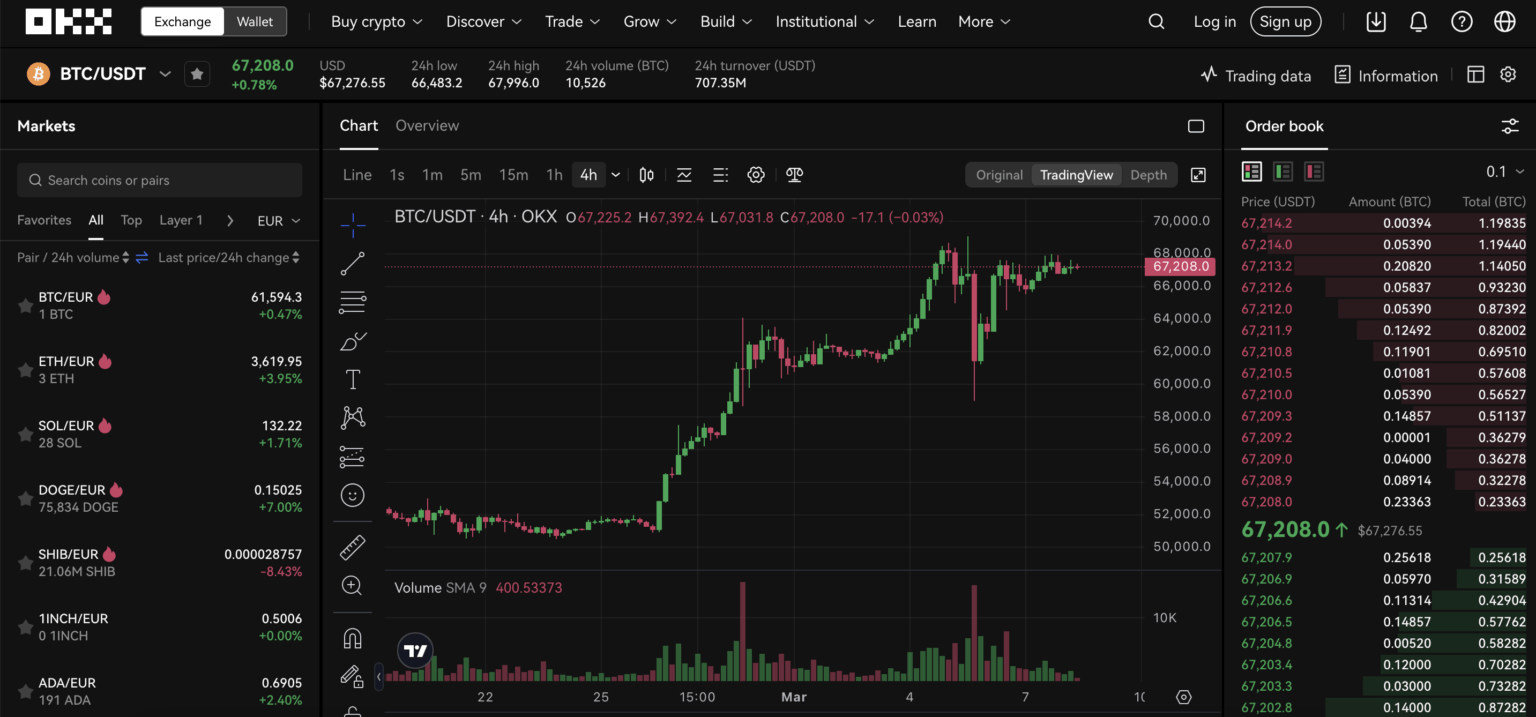
If you are a U.S. futures trader who needs low-latency access to perp swaps or 125x leverage on select products, use the centralized OKX account and enable strong 2FA and account notifications. That route gives access to TradingView charting, leveraged products, and high liquidity. If you are experimenting with yield farming or want to move tokens cross-chain using the OKX DEX aggregator, use the Web3 wallet and prefer a hardware wallet for significant value.
One decision-useful heuristic: treat the exchange account as “operating capital” and the Web3 wallet as “speculative capital.” Keep enough liquidity on the exchange to meet margin calls and execute strategy, but if you hold long-term assets that you don’t plan to trade actively, consider moving them to cold storage or to a hardware-backed non-custodial wallet.
When logging in, always verify the URL and prefer official clients. For a web sign-in walkthrough or help landing page, the exchange’s official login guidance will be faster than ad-hoc forum tips — see okx login for a direct starting point that aggregates the web flow and common troubleshooting steps.
Where the OKX model breaks down: limits and failure modes
There are three boundary conditions every U.S. trader should internalize. First, delistings happen and affect liquidity: for example, OKX recently removed multiple spot pairs (RSS3, MemeFi, GHST, RIO, SWEAT), a routine housekeeping action that can suddenly shrink available liquidity for affected tokens. Traders need exit plans before a delisting notice because liquidity can disappear faster than prices adjust.
For more information, visit okx login.
Second, AI-driven login protection is effective but not infallible. False positives or automated blocks can trap users during high-volatility events when they most need access. Have a verified support channel and secondary authentication methods prepared in advance.
Third, cross-chain activity and DEX aggregation introduce smart-contract and bridging risk. The OKX DEX aggregator optimizes routes across networks, but each step (swap, bridge, cross-chain transfer) adds execution and counterparty complexity. During market stress, slippage and failed transactions can cascade into significant losses.
Security checklist for the next time you sign in
Before you log in: confirm the domain, use a password manager to avoid reuse, and enable app-based 2FA rather than SMS if possible. For mobile users, enable biometric unlock but keep the authenticator app as a second factor. For Web3 interactions in the browser, use a hardware wallet for signing high-value transactions and review contract permissions before approving. If you operate algorithmic strategies, segregate API keys by permission: read-only keys for analytics, trading keys with withdrawal disabled for bots.
Finally, think in terms of incident response: know how to freeze withdrawals, rotate API keys, and contact support. Those operational moves are often more valuable than any single security setting.
What to watch next — conditional signals, not predictions
Two conditional scenarios are worth tracking. If exchanges continue to tighten token listings for regulatory or liquidity reasons (as in the recent routine delistings), expect more frequent liquidity events that will affect marginal altcoins — keep stop-loss and exit plans ready. Second, increased integration between centralized exchange wallets and non-custodial flows will improve convenience but also concentrate new attack surfaces; monitor how OKX and peers handle smart-contract audits, PoR transparency, and custody segregation.
These developments are not certainties; they are conditional on regulatory signals, market structure, and technology adoption. Each will change the trade-offs between convenience and control you face when you choose how — and where — to sign in.
FAQ
Q: Can I use OKX without completing KYC?
A: You can use the OKX Web3 wallet and some limited features without KYC, but centralized exchange features — spot orders, margin, futures, and withdrawals above regulatory thresholds — require KYC verification, including ID and liveness checks. The practical consequence is that meaningful trading liquidity and derivatives access are gated behind identity verification in the U.S.
Q: Is biometric login safe enough for high-frequency trading?
A: Biometric login is convenient and fast but should be paired with strong secondary controls for high-risk use. For algorithmic or FTX-scale trading, you want API keys with scoped permissions, IP whitelisting, and withdrawal protections rather than relying solely on biometric mobile unlock.
Q: If I move assets from OKX to the non-custodial wallet, do I lose PoR protections?
A: Proof of Reserves documents the exchange’s backing of deposited funds while they remain custodial. Once assets leave custody to your own wallet, they are no longer covered by the exchange’s PoR. That’s why the custody trade-off is important: PoR matters for exchange-held assets; it does not protect self-custody.
Q: What should I do if my login is blocked during a market move?
A: Have contingency steps ready: maintain a secondary 2FA method, keep API keys with restricted permissions for emergency trades, and know the verified support channels. If you rely on mobile biometric unlock, ensure you also have the authenticator app or backup codes accessible off-device.